|
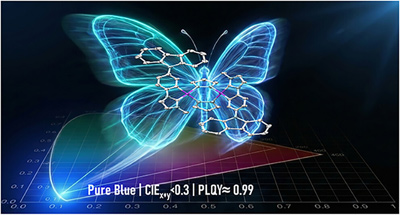
The Pt butterfly complexes, [{Pt(Cz-C^C*im)(μ-Rpz)}2] (HC^C* = 1-(4-(carbazolyl) phenyl)-3-methyl-1H-imidazol-2-ylidene; Rpz = pyrazolate (pz) 1; 4-fluoropyrazolate (4-Fpz) 2; 4-trifluoromethylpyrazolate (4-CF3pz) 3), with a carbazole-appended cyclometalated N-heterocyclic carbene (Cz-C^C*im) in the wings, were prepared and characterized. DFT and TD-DFT calculations show the prevalent 1/3ILCT character of the lowest-energy absorptions and emissions of these phosphorescent complexes. In 5 wt % PMMA films, complexes 1-3 exhibit blue phosphorescence with photoluminescence quantum yield up to 0.99, even in air. The Commission Internationale de L'Eclairage (CIE) coordinates of their emission are in the blue corner, being "pure-blue" (CIEx+y < 0.3) in the case of 1. In view of these properties, these complexes were used to prepare OLEDs, with the best-performing devices achieving a maximum external quantum efficiency of 4.26% and maximum luminance of 2357.7 cd m-2 with cyan electroluminescence (CIEx,y = 0.14, 0.46).
|