|
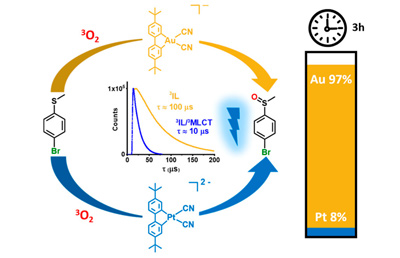
The d8 complexes A[Au(C^C)(CN)2] and A2[Pt(C^C)(CN)2] (where C^C = 4,4′-di-tert-butylbiphenyl-2,2′-diyl and A+ = NBu4+, K+) were synthesized from [Au(C^C)Cl]2 and [Pt(C^C)COD], which were themselves obtained from Sn(C^C)nBu2. These complexes are bright photoemitters but exhibit remarkable differences in the origin of their photoluminescence. The tin complex Sn(C^C)nBu2 displays blue/white photoluminescence originating from an admixture of transitions. In contrast, the gold complexes exhibit green, long-lived phosphorescence (lifetimes up to 100 μs), which theoretical calculations attribute to 3IL(C^C) transitions. Although the platinum complexes show similar absorption and emission energies, theoretical calculations indicate an admixture with 3MLCT character in their emissive states. This is evidenced by (i) luminescence lifetimes up to 1 order of magnitude shorter than those of the gold complexes under similar conditions; (ii) a greater contribution from fluorescence with respect to phosphorescence in solution, and (iii) reduced susceptibility to 3O2 quenching, a consequence of the shorter triplet-state lifetime. The combination of water solubility, efficient ISC, and a long-lived triplet state with high sensitivity to dissolved O2 endows K[Au(C^C)(CN)2] with excellent catalytic activity in the photo-oxidation of p-bromothioanisole. This result underscores the potential of this class of Au(III) salts for photocatalysis in green solvents.
|